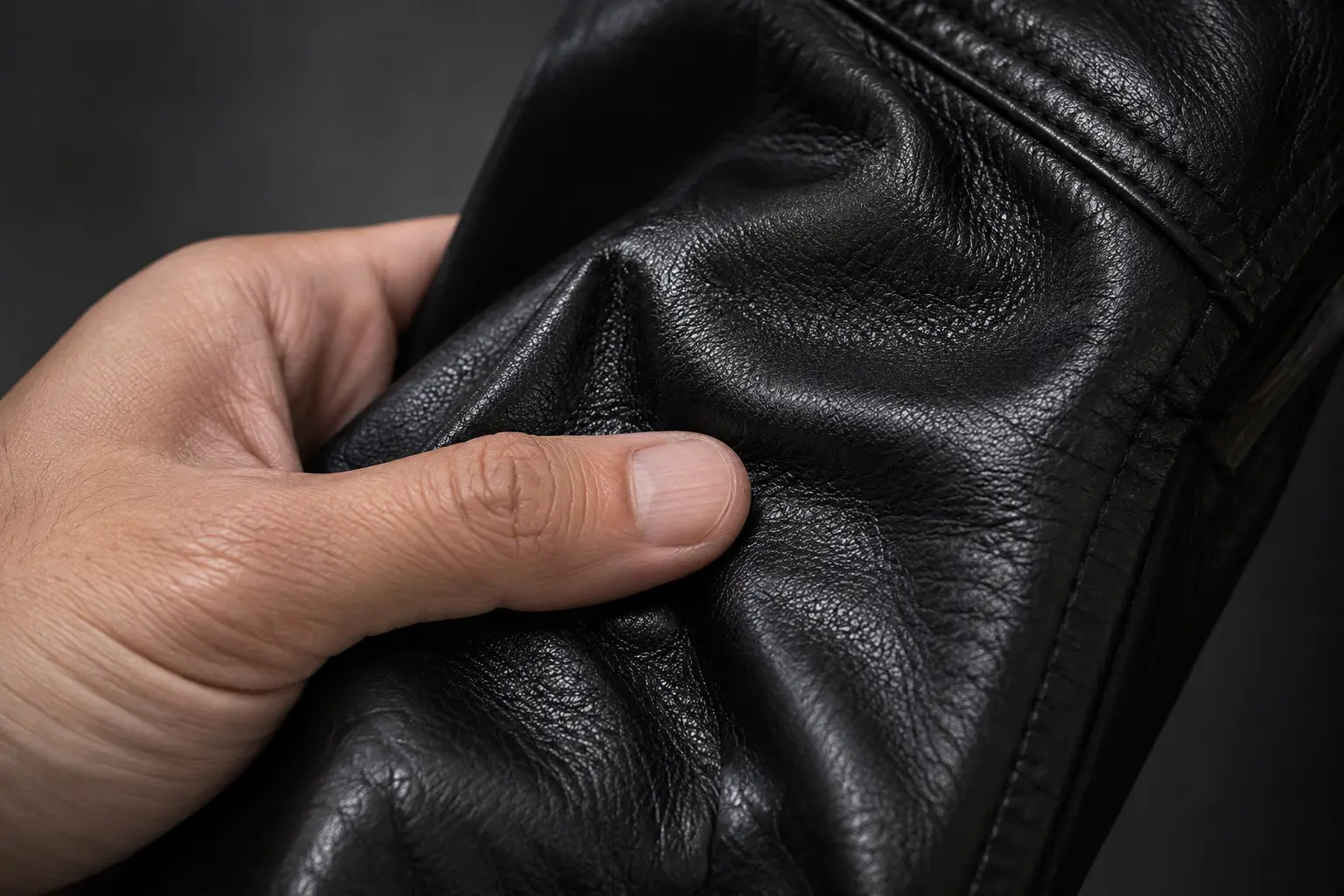
Buying a leather jacket is an investment — and nothing is more frustrating than paying premium prices for a jacket labeled "genuine leather," only to find out later it's synthetic. With vague terms like vegan leather, PU leather, and leatherette everywhere, knowing how to identify real leather vs. faux leather before you buy is the single most important skill for any smart shopper.
In this guide, we'll break down exactly how to tell real leather from faux leather using six practical tests — the same checks our own product team runs before any jacket goes into the Blackstone Jackets collection.
Why the Real vs. Faux Leather Difference Actually Matters
Genuine leather and faux (synthetic) leather aren't just different in feel — they're different in performance, lifespan, and value. Real leather jackets, when properly conditioned, can last 20–30 years and develop a rich patina over time. Faux leather, on the other hand, typically starts cracking and peeling within one to two years of regular wear.
This becomes even more important when shopping online, where you can't physically touch the product before buying. That's why every listing at Blackstone Jackets clearly specifies leather type and grade, so you always know exactly what you're getting before it ships.
Six Tests to Identify Real Leather
01
The Touch Test
Real leather has a naturally uneven, slightly rough texture with visible grain — no two spots feel exactly the same. Faux leather feels artificially smooth and consistent across the entire surface, almost like plastic. If it feels too perfect, it's likely synthetic.
02
The Smell Test
Real leather has a distinct, earthy, slightly musky smell — the same one you'd notice in a leather car seat or an old bag. Faux leather usually smells like plastic or chemical coating. If it smells like a shower curtain rather than a saddle, that's a red flag.
03
The Grain Pattern Test
Genuine leather comes from animal hide, so it naturally shows imperfections — small scars, wrinkles, and pore variation. Faux leather is manufactured, so its grain repeats in an almost printed, uniform pattern. If the texture repeats every few inches, it's synthetic.
04
The Water Drop Test
Place a small drop of water on a hidden inner seam. Genuine leather is porous and absorbs it slowly, darkening slightly at the spot. Faux leather is non-porous — the water will simply sit on top or bead up.
05
The Price Test
Genuine full-grain leather jackets typically start around $150–$200 and go up with craftsmanship and finishing. A "100% genuine leather jacket" priced under $50 is almost certainly synthetic — real hide simply can't be sourced, tanned, and stitched at that cost.
06
Check the Label and Fine Print
Watch for these terms on the tag or listing:
- Genuine Leather — real leather, but often lower-grade (can include bonded leather)
- Full-Grain / Top-Grain Leather — the highest quality real leather
- PU Leather / Faux Leather / Vegan Leather / Leatherette — synthetic, not real hide
Reputable sellers list this clearly. We specify the exact leather grade on every men's leather jacket and women's leather jacket listing — because transparency builds trust, and trust is what keeps customers coming back.
Real Leather vs. Faux Leather: Quick Comparison
| Factor | Real Leather | Faux Leather |
|---|
| Lifespan | 20–30 years | 1–3 years |
| Smell | Earthy, natural | Plastic / chemical |
| Texture | Uneven, natural grain | Uniform, smooth |
| Water absorption | Absorbs slowly | Sits on top |
| Price | Higher | Lower |
| Breathability | Breathable | Less breathable |
What Real Leather Looks Like in Our Own Collection
The clearest way to understand these tests is to see them applied to real products. A piece like our brown crocodile embossed real leather jacket passes every test above — visible natural grain beneath the embossed pattern, a genuine leather smell, and slow, even water absorption on the inner seam. Compare that against a synthetic jacket in the same price bracket and the difference becomes obvious within seconds of handling both.
If you're specifically shopping for embossed or textured finishes, it's worth reading our companion guide on exotic embossed leather, since embossing can sometimes make it harder to spot the underlying material at a glance — the six tests above still apply regardless of surface texture.
Common Myths About "Genuine Leather" Labels
A lot of buyer confusion comes from marketing language rather than the material itself. Here are the most common misconceptions worth clearing up:
- "Genuine leather" means top quality. Not necessarily — it's a legal minimum threshold, not a quality tier. It can legally include bonded leather, which is the lowest-performing grade on the market.
- Embossed or textured leather is automatically fake. Embossing is simply a heat-pressed pattern applied to genuine hide — it doesn't indicate synthetic material on its own. Always run the smell and water tests regardless of surface pattern.
- Expensive always means real. While price is a useful signal, it isn't foolproof. Some brands mark up synthetic materials aggressively, so combine the price test with at least two of the other five checks.
Buying Online: What to Ask Before You Purchase
Since you can't physically test a jacket before an online purchase, ask the seller directly for the leather grade (full-grain, top-grain, or genuine), request a close-up photo of the interior seam, and check whether the return policy allows you to verify the material once it arrives. Our own full-grain vs top-grain vs bonded leather guide is a useful companion read here, since grade and authenticity are two separate questions worth confirming together.
Which One Should You Choose?
If you want a jacket that ages beautifully, molds to your body over time, and lasts decades with proper care, genuine full-grain or top-grain leather is the better long-term investment. If budget or animal-free materials are your priority, quality faux leather can still look great for casual, short-term wear.
Once you've picked your material, don't forget the second most common buying mistake — poor fit. Check out our guide on how a leather jacket should actually fit to make sure you're not sacrificing style for comfort. And once your jacket arrives, our leather jacket care guide covers exactly how to keep genuine leather looking its best for years to come.
Where Real Leather Genuinely Outperforms Faux
Beyond the six tests above, it helps to understand why genuine leather commands a higher price — because those reasons are exactly what you're paying for. Real hide breathes, meaning it regulates temperature far better than synthetic alternatives that trap heat and moisture against the body. It also molds to your frame over time, developing a personalized fit and a rich patina that no two jackets ever share. Faux leather, by contrast, stays exactly as it was made — it never improves, only degrades.
This difference shows up most clearly across full-grain pieces. A men's biker jacket or a women's leather jacket built from genuine hide will often look better after five years of wear than it did on day one — something synthetic material simply cannot replicate.
Common Places Faux Leather Gets Sold as Real
Fast-fashion retailers and unbranded online marketplaces are the most common places where synthetic material gets marketed with misleading "leather" language. Watch especially for listings that use the word "leather" in the title but bury "PU" or "man-made material" in the fine print, or that show heavily edited product photos where the texture looks suspiciously uniform across the entire garment.
The safest approach is buying from sellers who state the exact grade openly. Across categories like our men's bomber jackets, women's bomber jackets, and even kids biker jackets, the leather type is specified directly on the listing — because a brand confident in its material has no reason to hide it.
The Bottom Line on Real vs Faux
Genuine leather is a long-term investment that rewards you with decades of wear, character, and comfort. Faux leather is a short-term, budget-friendly, or animal-free alternative that looks the part initially but rarely lasts. Neither is objectively "wrong" — the right choice depends entirely on your priorities. What matters most is knowing exactly which one you're buying, so you never pay real-leather prices for synthetic material. Use the six tests together, check the grade openly stated on the listing, and you'll never be caught out.